03 September 2017

Moonless night

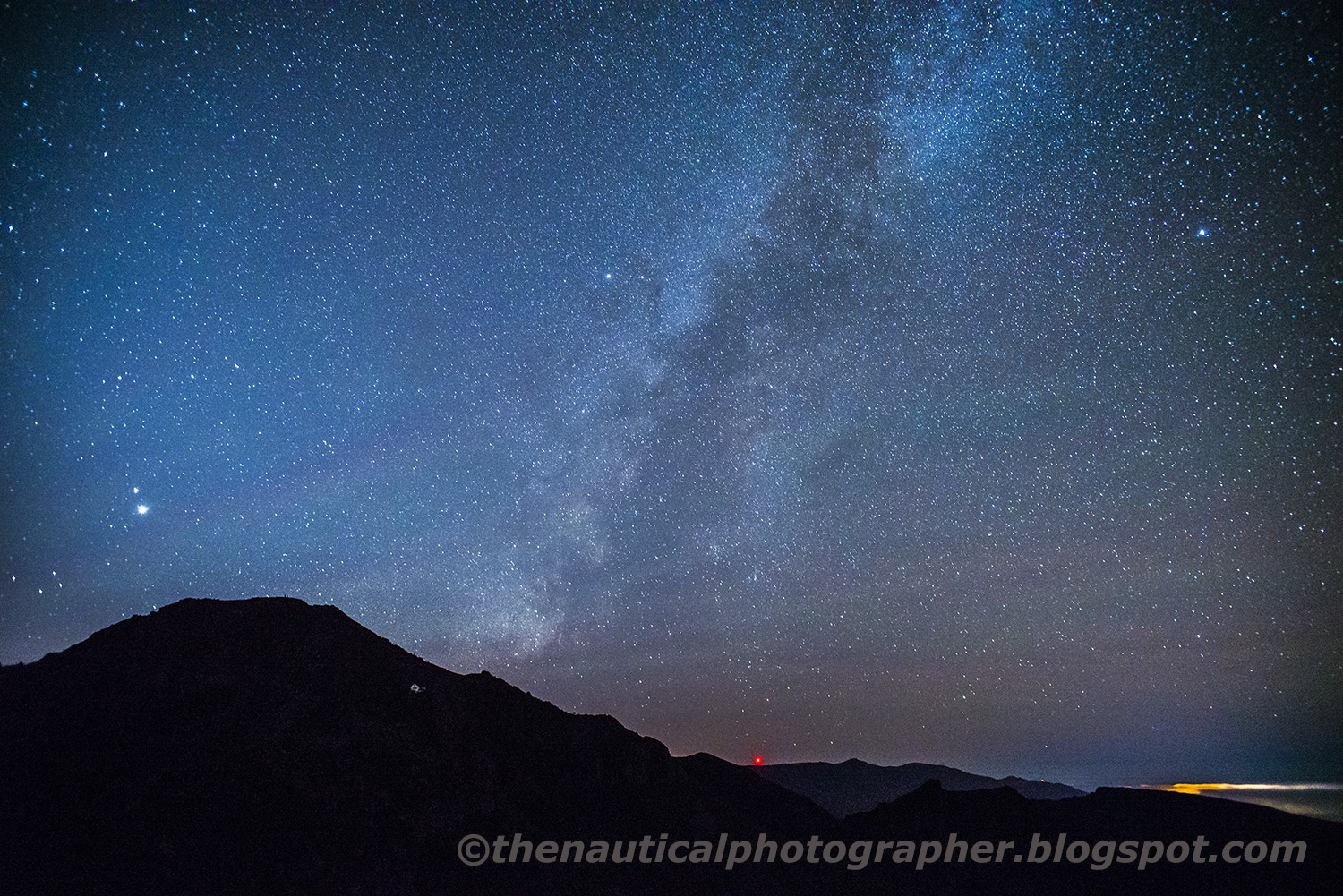
According to the astro-photographers, moonless nights are the best to make this particular type of photography. The reason for that is obvious: most of the time the moonlight is so intense that, for the exposure needed to correctly record the celestial bodies, all the foregrounds will be prohibitively over-exposed. Most of the times pictures are taken above ISO 3200, with shutter speeds around 20 to 30 seconds (more than that and you risk star trails on the final image) and apertures between f/1.4 and f/4.0.
This particular case, althought not even close to be considered a good photograph, gives you a general idea: I wanted to shot the Milky Way against a mountain humanized foreground. So I choose the Achada do Teixeira abandoned hut/restaurant, at 1600 mts above sea level, as my foreground. Placed the camera on tripod and choose my point of view for composition. ISO 6400, f/4.0 and 30 secs exposure gave me the best result possible for the Milky Way. Problem was that the hut would become a dark, textureless, shadow using those parameters. Increasing the exposure to lit the hut would only burn out the sky, due to the residual amber light reflected to the atmosphere from the villages down under, at sea level.
So I opted instead to "paint" with light, for about twenty seconds while the shutter was open, just a little bit of the foreground, from the position where I stood with the camera and with a simple pen-sized-chinese-made LED torch, powered by two small AAA alcaline batteries.
That a modern digital camera sensor can suck so much light from such a weak light source is to me beyond believe. I can easily imagine that twenty five years ago to have the same lighting effect on the set of a movie production with a motion film camera you'd need at least twenty thousand Watts of light to achieve the same result. Now all you need is a highly sensitive digital sensor and a pocket flash light.
So, although I'd say this modest example is light-years away to be considered photographic art, I think you (no pun intended) get the picture.
Picture taken with Nikon D610 and Vivitar manual 24mm f/2.8 lens. Sirui Travel T005 light tripod and kit ball-head. Post-processing in Adobe Photoshop CS6.

04 August 2017

Seiko Divers Kinetic 200

Why would I need another diver’s watch? Another timepiece to end up in a small drawer already filled up with, as any competent watch fan would recognize, substandard time measuring machines?
Well, in fact… I don’t. We could say, however, that there are worst ways of spending our hard-earned money. But I’m far for being a collector also.  It’s more of a healthy curiosity, I imagine.
Maybe it’s their mechanical complexity that is so attractive, so addictive. So many precision components working together in perfect balance and harmony with the simple task of dividing the days in hours, minutes and seconds.
The  lovely Seiko Divers Kinetic, with the reference number SKA371P2, is a very interesting introduction to the diving watches' , giving you you a "lot of bang for the buck" in a truly ISO certified diving watch.

However, I’d say, there’s a bit more to it. More than the simple amusement we have when looking at one of those fragile mechanisms that seem to have a life of their own, while the rotors and the escapements move and the little thing looks like a tiny heart, pulsating, tick after tick.
Can we imagine a more obvious mechanical metaphor to our living human condition?
So, why would I need another cheap divers watch? Well, I’ve never owned a Seiko and money was a bit short for a “Grand” one. And although I admire the elegance and technical mastery achieved by the dress watches, my heart always leant for the tool ones.
A simple design, with a flat Hardlex crystal and  a deep and easily readable dial. 120 clicks ,one-direction, turning bezel, the usual (over-sized and easily handled) screw-down crow. The lume is second-to-none, as per Seiko's standards and tradition. As a single complication: a date window at three o'clock. The push-button above the crown just tell us the the kinetic engine power-cell reserve. Honestly, do we really need anything more than that?

To me, basically, a wrist watch is an extension of our bodies. We live with it through the day. Heck, we even sleep with it sometimes. This means it has to sustain its daily amount of abuse without complaining. And while we are seeing the appearance, on the past decades, of several variations on the concept (field watches, pilot watches, alpinist watches, etc.), truth is, structurally speaking, dive watches are, still today, reference watches in terms of durability and toughness.
The reason for that, being, in my modest and deeply amateur opinion, due to three factors: reliability, simplicity and robustness.
The Seiko Kinetc Divers SKA371P2 is as solid as a divers watch can be. The case has an interesting design, mixing smooth and round contours with more harsh lines. But, hey, japanese design was never famous for being "classical". The screw-down case back has the already famous "tsunami" logo engraved on it. Can this be the quintessential diving watch? Well, it can well be. But this is a subjective matter. Objectively speaking, this is a wristwatch that you can use and abuse, without being worried to pay several hundreds of Euros just for minor repairs. For a price tag just under the 200 Euros you just trash it to the can, if needed be. Or pay a few dozen Euros for repairing it. Remember just one thing: forgetting for a moment their high level of reliability, Seikos (or Citizens and Casios, for that matter) are the Toyotas of the watch world. Everywhere in the globe you'll find competent technical assistance and spare parts.

Reliability, I’d say, in these particular timepieces, is normally hand in hand with simplicity. In fact most of the diving watches just tell the time. The more common complications (chronograph functions, date or GMT hands) are not true necessities to accomplish its basic function. If there’s a detail that distinguish them from the rest of the crowd it’s the rotating bezel, formerly used for dive time and decompression calculations, on a Era when diving computers were science-fiction material.
Avoiding movement complexity leads the design to simpler mechanisms. And with simplicity comes a lower probability of malfunctions. This is just basic common sense, valid for any human endeavor.
Regarding robustness, their design speaks for itself: compact stainless steel cases with screw-down crowns and case backs. With these two characteristics, a diving watch is as weatherproof and water-tight as a wrist-watch can be. It simply can’t be much tougher than that.
And amongst the many in the world, Seiko produces some of the best. Curiously, I first got acquainted with the brand already in my adult years. It was only during my seafaring years that I started noticing some of my fellow shipmates wearing Seiko watches (although not necessarily divers). The general preference for the brand was a mystery to me, until I noticed that during the seventies and the eighties it was common for the Portuguese merchant fleet (what was left of it) to sail on the Indian basin and on the Western Pacific. Macau, Hong Kong, Singapore and Yokohama, to name a few, were, at that time, some of the ports on the area where you could buy a few nice things still rare in Europe. Wrist watches were some of them, immediately followed (but not necessarily on this order) by electronics and photographic cameras.
The strap could be a little bit better? Well, it could. Instead of plastic, a more noble material could have been choosen, like rubber or silicone.But that would also put a price on durability. Fact is we can always look for faults if we look hard enought. Does it really matter, on my daily use? Not really.

So, after that introduction I started to look at the brand with a detailed attention. And, in fact, at sea, it was present nearly everywhere: in my shipmates’ wrists and also as ships clocks, master clocks and chronometers.
And, you can call me pretentious (or, perhaps, it’s just a bias), but after all these years it’s still to me a sign of a very good taste seeing a fellow seafarer (man or a gal) wearing a Seiko.
And that is, basically, for a reason. Although can I easily recognize that I’m leaded by preconception, we all agree that, to a vast extent, in the present bling society where we are living in, the suit makes the man. Naturally, the correctness of this assumption is another story.
And, somehow, I guess, the equivalent to an Armani suit in the watch world is a Swiss-made one.
But, truth be told, and I’m by no means an expert, there’s a reason why they include them in the chapter of luxury brands: simply because they can. They were always top of the line timepieces. It’s a fact. But I remember visiting a watch shop in Lisboa with my mother during the early eighties.
On those days the one catching my attention (as if I could afford it) was the Rolex Sea-Dweller.  At the time, that watch was priced just a tad above 1000 Euros, whereas a Citizen Aqualand (the first model, just fresh out of production) was costing around 270 Euros. So, on those days, a top of the line Swiss Rolex diving watch (the best divers of the brand, at the time) was costing four times as more as a Citizen Aqualand. Nowadays, you can buy the modern Aqualand model for 500 to 600 Euros. Tops.  Good luck trying to find a new SeaDweller for less than 8000.
Can you, as a consumer, find any logic in this? Neither can I.
But, hey, we all know that the vast majority of people wearing these watches couldn’t care less about time keeping. In fact, for most of them, time is dictated by others. Therefore, the much more important and needed I-Phone - also telling you the time - will suffice. These expensive watches are bought mostly as an exhibition of social status, power and financial wealth. Pretty much like buying a Harley-Davidson instead of a Honda. Or choosing Leica over Nikon. People who buy them couldn’t care less about the craftsmanship. And, seriously, how many people do you know, besides navigators, really needing a certified chronometer on their wrists?
Nowadays we have to recognize this behavior for what it is: a simple manifestation of vanity. But we have to understand that, like peacocks, we always love to show our most beautiful and colorful feathers. Did we really evolve all that much since those earlier days on the sunny planes in Africa?
Fact is this status-quo already reached the merchant fleet. And it became too common to see, presently, Officers on board wearing the flashy Swiss things: Rolexes, Breitlings, Omegas, JLC’s, you name it. Particularly on the cruise ship industry (where looks and pantomime are everything, or pretty much most of it) you get so tired of seeing one with a better (more expensive!) watch than the other that their use is becoming vulgar. There’s less and less place for imagination, creativity and individuality – if you like – because all of them are using the same 8000 Euros pieces of time-keeping, only in different shapes.  Curiously, in this particular case, there’s a great relationship between vanity and nationality (I promise I won’t go further, for the sake of good comradery). Generally, you can easily tell the nationality of the crew members for their flashy time pieces. And the opposite is also true. The most unpretentious ones are from particular nations. And these aren’t really countries famed for being low-income ones. Oddly, we are forced to recognize this particular behavior as a cultural thing.
As an interesting detail, the lugs are perforated from side to side. Although it breaks somehow the continuity on the elegant case, thruth is this is quite a useful feature for quicker strap changes.

So you can imagine my satisfaction when I see a fellow colleague wearing a discreet Seiko (or a Casio or a Citizen, or a Timex for that matter!). To me, he (or she) isn’t following the crowd. And instead of burning a horrendous amount of money on a vanity stunt, their choice is lead to a reliable and discreet piece of engineering. They couldn’t care less. It’s their way of sticking it to the man, if you like.
But don’t be fooled by the comparatively lower prices in relation to the Swiss ones. The heritage is there, since Seiko history is already a long one. Technically speaking they are leading the way, still today, in watchmaking. Their innovations and patents are vast. They even have their own in-house chronometer calibration bureau; a reference in the field and with more strict standards than the Swiss COSC one. Simply put we can say that a movement that passes Seiko chronometer standards will easily passes the COSC test. However the opposite is not always true.
So Seiko isn’t, by any means, just another brand. So what if they are able to produce both cheap and expensive movements under the same name. Their exquisite engineering is as much to praise as their middle-class, common man, products. Both made with the same respect for the consumer and under the highest professionalism. After all, it’s Japanese.

30 April 2017

Summer's coming!

Always a pleasure to visit the island of Porto Santo during this time of the year. We are still in mid-Spring, but it's like we are already in Summer. The atmosphere gets clearer and all the natural formations seems to be closer and bigger than they actually really are. The few occasional rain showers are a blessing at this time of the year, to fill up the levadas, instead of a premonition of stormy weather to come.
The air temperature, although still a tad on the cold side, doesn't discourage the occasional stroll at the peaceful evening time, along the sand patch of one of Portugal's most beautiful beaches. With everything that surrounds us in perfect harmony.
A bucolic Porto Santo scene, photographed yesterday, around 2130, with the whole beach pretty much for myself, following the berthing manoeuvre of the M/T Letízia Effe (IMO 9373230).
Picture taken with Nikon Coolpix P7100 and cheap Polaroid PLTRI42 light tripod. Post-processing of the NEF file and conversion to JPEG in Adobe Photoshop Lightroom.

20 April 2017

Life’s a circle.


Photo:
Ceramic wall panel on the Megre family country house, in Águas, northern Portugal; depicting the many voyages made by José Megre during his lifetime. An homage of the Penamancor City Hall to one of the county's most illustrious sons.
 
Months ago, one of my regular travels to the mainland was as much a periplus as it was a pilgrimage.With the purpose of visiting my alma mater, to fulfill some academic duties, I decided to make the best of those short eight days in the continental  Portugal and, school compromises solved, head out to the Northern part of the country, to the Beira Alta region, steering my course towards the Central Massif to enjoy a few peaceful days of mountain air, surrounded by the high peaks of granite before returning to my island.
For a few reasons, I’m glad I’ve done it. Because that short trip was one of discovery and reflection.
 
He was a reference to many. Both mature and young people alike.
A mechanical engineer by college formation and early profession. A former Army Comando, with war commissions in Angola. An adventurer and a leader. A writer and a communicator. A grown man who, I can easily imagine, never ceased to look at the world with a youngsters' eyes.
He was also a father and a husband. A family man.
José Megre was all of this and, certainly, a bit more.
To the common layman, myself included, he was mostly the “father of the Portuguese off-roading  movement”. He started it all, during the late seventies and early eighties, when this poor nation, freshly recovered from the Carnation Revolution, was opening up herself to the modern world and Europe.
 
There were many famous Portuguese adventurers through the ages. Many more forever anonymous, forgotten by History, although they were part of it. We were always a country of voyagers. Of dreamers. Of people trying to see beyond the horizon. A poet once said that this nearly millenary nation is too small for her own people. Hence the diaspora.  And the simple, unquestionable, fact that anywhere in the world you’ll find a Portuguese.
José Megre had it on his genes. The “carpenters' bug”, as we say in Portuguese. A restlessness that forces us to move ahead. To unknown territories, mostly within ourselves.
 
Like for so many young kids of my age, avid readers of Jules Verne and Jack London, he was Mr. Adventure personified.
Sadly, I never met him in life. He was already a seasoned respected voyager while I was still in elementary school. Our paths never crossed. And today it’s already too late. So, I’ve decided I’d pay him a visit on his last resting place, when I had a chance.
 
So here was I, together with my faithful Citro AX GT, my very own modest, unpretentious (to say the least!) and timid approach to the motorized sports, at the gates of Águas one September afternoon.
Águas, like so many villages in the Portuguese mountainous interior, has a telluric relation with the Earth. The austere granitic architecture, seen from afar, looks like a part of the natural landscape. Like so many towns around, Águas seems stopped in medieval times. I sometimes wonder how can this be possible. How can a country be so full of contrasts, between modern and old, between futuristic development and the total lack of it. And all of this in a rectangle of 90.000 square kilometers.  How can this diversity be possible in such a small area? A nation smaller than most of the USA states?
For an American citizen, used to its square-grid modern cities, where everything looks the same in the landscape for hundreds of kilometers regardless of the direction taken, the fact that the scenery changes at every fifty kilometers must be puzzling.
 
The central square of the small town is dominated by two main buildings, constructed side-by-side: the Catholic church, built in a neo-gothic style, and the country house of the Megre family, his own.
He was the son of one of many aristocratic and bourgeoise landowning families so common in Portugal’s interior during the XVIII, XIX and early XX’s centuries.
So, financially speaking, he was a wealthy person, having born within a rich family, whom, according to a local inhabitant , owned the vast majority of the land surrounding the village. But would that factor alone explain his devotion to motorized sports early on his life? And the later pursuit of adventure that led him to organize the first Portuguese team to race in the Paris-Dakar rally, during the early eighties?
And his passion for travel, fueled late in his life, that drove him to visit – in his own words – “all the nations of the world, except one”?
Hardly.
 
That’s an ambition, a need for fulfillment that has to come from within. And although money does help, it doesn’t justify it entirely. Otherwise, how could we explain the thousands travelling the globe as we speak without a dime in their pockets?
Someone said “every voyage is an unsatisfied anxiousness”. I would concur with the author. There’s a certain restlessness that some people have that always seems to move them to perpetual motion. José Megre, we can easily imagine, was part of those few. Living life by his own terms. Facing challenges where all the others saw unclimbable mountains.
 
Now, I cannot help but to think about the ephemeral nature of life and how dramatically short it is. There’s never enough time to fulfill our own very personal definition of destiny, although I’d say that José Megre approached his.
And after nearly forty years of an adventurous life, that took him to the four corners of the world, he found rest in here. In the same old town where he probably used to play as a child and, perhaps, dreamt with those faraway places he’d love to visit someday.
And, with that final act, he closed the circle.

27 November 2016

Dreams of Aneto

(Or the affective life of the Pyrenean marmots)

A street in the mountain town of Benasque.
 
Benasque was a dream of youth. An almost mythological place which name I used to whisper, in an age when the world still seemed infinite and my childish future career plans were a crossing between Galen Rowell and Sir Edmund Hillary. To a kid of fourteen who had never left Portugal, the Pyrenees might as well be in Bhutan.
Meanwhile, amongst readings of well-intentioned authors and day-dreaming, I got older. And like the vast majority of the human race, while we progress in life, from beginning towards the unavoidable ending, we have the sad tendency to replace romantism for pragmatism.
Like a very personal and intimate civilizational crash, to me that happened abruptly around my twentieth birthday.
Someone once told me that “in a family the younger child does what he wants to do and the older one does what he has to do”. Being the older brother in the family I knew what I had to do, alright: achieve my independence as soon as possible.
So at twenty I was choosing seafaring life over bum life (for some, they aren’t really that different, you know?) and a few years Iater I was finally living a totally independent life. On the side of that path I left a few (questionable) dreams.
The Renclusa hut. Departing point for so many adventures in the Posets-Maladeta massif...
...and the cool marmots living on the neighborhood.

Well, although I may hold some bitterness for a dreamt future never fulfilled, truth is I’m glad, so far, how things turned out and the Earth’s spinning movement drove my life to the present moment in time.
To me, for decades, and pardon my lack of ambition, the Aneto was my “Everest”. As the actual Everest is the Everest for so many.
The Mahoma step in front and the last problem before the summit.

Now, twenty-six years and kilograms later from my first visit to the biggest Iberian cordillera, I was finally standing at the top of the Pyrenees highest peak, after a seven-hour climb from La Renclusa (well, it was more like a high-mountain hike) and wondering why was I so lazy in the last quarter of a century.
After kissing the Virgen del Pilar statue that adorns the summit and while looking East, to the uncomfortable Mahoma step I’ve just crossed and to all the people following the same path, I finally understood it.
Like Monte Perdido, that I ascended twenty-six years ago, and, perhaps, the iconic Mont Blanc, this wasn’t just a climb. It was a pilgrimage.
Far from being just, in the words of legendary French climber Lionel Terray, “conquests of the useless”, there’s a lot to be learn, on a spiritual level, about such accomplishments.
We are living in an Era with fewer geographic boundaries to overcome. With less and less blank spots on the world map to be cartographed, and the progresssion curve of human physical capabilities leaning slowly to the horizontal plane, we find ourselves slowly steering from the Neanderthal-like bravado to a more spiritual level.
The statue of the Virgen del Pilar looks at the distant horizon from the highest summit in the Pyrenees in a particularly peaceful June morning.
 
The same also happens in mountaineering, where, after all the important conquests have been achieved, the only objective still worthy of a look is the ascension of Everest during the winter season, oxygeneless,  solo and… errr… bare naked.    
In the end, regardless of the narcissists’ childish opinions, reaching the high peaks accounts for just that: a deeply personal, metaphysical and spiritual experience that, hopefully, will bring a bit of light to the mysteries of our lives and, by that, perhaps, contributes to give us a better understanding of ourselves and the others.
But, above all of that, within the most intricate corners of our souls, we all secretly believe that it will lead us closer to God.
 
All the pictures taken with Nikon P7100

27 December 2015

Merry Christmas

Christmas in Porto Santo island.
Picture taken at dawn, in Vila Baleira central square, with Nikon P7100 secured in a cheap Polaroid 42" travel tripod and post-processed in Adobe Photoshop Lightroom.

12 August 2015

Luxuriant

The dense and luxuriant Laurissilva forest in Pico das Pedras, on the North coast of Madeira.
Picture taken with Nikon D300 and Tamron SP AF 90mm f/2.8 Macro lens. Manfrotto tripod and Junior geared head. Post-processing in Adobe Photoshop Lightroom.

07 August 2015

Sophisticated weather station

Looking for a replacement for my cheap digital no-brand cr.. weather station, which I bought six years ago in a general store, I began a few weeks ago to do a bit of searching.
In the Funchal Pilot station we have the trustworthy (for advanced amateur standards) Davis Vantage Pro 2, well renowned by weather buffs worldwide. For use at home, however, the price of nearly 700 Euros is a deal breaker, since I also don't need so much complexity and parameters. Now I'm looking for accurate, simpler and cheaper. A few days ago, aboard the Icelandic research vessel Neptune, I've noticed this advanced equipment that seems to fit the bill. The only drawback is the inexistence of a reseller in Portugal.
Picture taken aboard the RV Neptune (IMO nº 7504237), with Panasonic DMC-FT3 compact digital camera.

Summer diet

Only our natural and ever-present human arrogance allow us to, sometimes, forget our actual position on the food chain: somehow nearby the middle.
For many of our fellow inhabitants, within this tiny blue ball drifting around in the universe, we are nothing more than a nice and tender snack.
Picture taken along the shoreline of Olinda, in the Brazilian state of Pernambuco, with Nikon D40X and cheap Nikkor DX 18-55mm standard zoom lens. Post processing in Adobe Photoshop Lightroom.

21 July 2015

Summer weather

During my seafaring career, we used to pray for days like this. At sea the weather simply cannot be better than this. The sea surface with the texture of olive oil and the "good weather cumuli" reflecting on the calm surface below. Sea of ladies, we used to call it. Because if it was always like that even (more, I add) women would be seafarers.
Sea of ladies indeed.
Picture taken on the mountains of Madeira, facing the North coast and the town of Santana, with Nikon D300 and Sigma EX 18-70mm f/2.8. Post-processing in Adobe Photoshop Lightroom and Perfectly Clear Lightroom plug-in.

05 July 2015

Facing hell

Besides the danger of sinking or capsizing, fire at sea is, probably, the most dramatic event that a seafarer may face while on duty at sea. To the layman a fire at sea doesn't sound so different as the same scenario ashore. Nothing could be further from the truth. When a fire erupts on a ship at sea, the crewmembers can't go anywhere. They can not retreat to a safer distance, assess the situation and then return to face it, already in the possession of a solid strategy and probably assisted by professional fire-fighters. No. At sea, at two days voyage from the nearest port and unable to be assisted in a short practical amount of time, they have to face the monster themselves. Or resign. And watch the vessel burn to ashes.
Since only a few Merchant Marine units worldwide have a team of professional fire-fighters on board, merchant mariners worldwide have to perform that duty if the divine providence puts them in the presence of such a scary moment. The Advanced Fire Fighting Course was one of the several courses we had to take before our seafaring books were issued and we were considered ready to surf the mighty ocean.
When we made the AFFC, in the early nineties, in Alfeite (Lisbon Naval Base), we were all far from imagine how stressful a real fire-fighting situation could be. A few years later I would recognize the valuable instruction that we received in those two intensive days, when we had a small (it was really small!) fire in the ship's galley. Nothing special. Just a paint of oil from the roast chicken that slipped from the tray and ignited the moment it touched its heating elements. In took us a mere ten seconds since the cookie screamed "fire" to storm the galley with a Chemical Powder Fire Extinguisher and we had already to find our way to the source of the fire like blind people, unable to see more than two fingers in front of our faces. From that moment on, surrounded by a black, thick and impenetrable smoke, I developed a deep respect about fires on liquid fuels. One could only hardly imagine the same scenario in the engine room.
Picture:
Bulkhead in flames for a demonstration of fire suppression techniques using ABC Chemical Powder Fire Extinguishers, in Lisbon Naval Base. The correct technique is here demonstrated: you have to fight the fire from the lower level to the higher one, pointing the fire extinguisher's nozzle from down to up. The smart use of the fire extinguisher's available capacity is the most important factor while fighting a fire.
Picture taken with Pentax SF1 and Pentax 50mm f/1.7 KAF lens on Fujicolor HR100. Scanning in Nikon Coolscan V ED and post-processing in Adobe Photoshop Lightroom.

26 June 2015

Echoes of the past

When we visited it, in 1992, nearly a quarter of a century ago, the Natural Park of Alvão was one of the most remote places in the continental Portugal. At the time, it was short on the famous connecting highways that are today a cause for political controversies.
In those days, however, we'd gladly enjoy their convenience if one existed that could reduce the long voyage from Lisboa to the massif, deep inside the Trás-Os-Montes province, on the NE Portugal. After a ten hour voyage that looked to us, still youngsters in the mountaineering business, like an expedition in itself, we finally arrived, late in the evening, to the high plateau of Serra de Alvão and to a remote small village called Lamas de Ôlo, where we improvised a bivouac in an old and abandoned watermill.
A perfect example of a Portuguese mountain village, this small place, now home of barely one hundred souls, surprised us by the beauty of its archaic architecture, with most houses built with granite and schist.
On the village's highest place stood tall, as a lonely sentinel, the community bell. A remainder of a not-so distant past, when the village had to depend on itself against the many menaces their inhabitants could face. And when words as solidarity, teamwork and union were used on a daily basis.
I have never returned to Alvão.
Old picture taken with a Pentax SF-1 film camera, with the, at the time, standard 50mm f/1.7 Pentax KAF lens and with a Agfapan B/W 100 ASA film. Scanning in Nikon Coolscan V ED and processing in Adobe Photoshop Lightroom.

25 April 2015

Christ of Garajau

The solitary statue of the Christ of Garajau, resting on the promontory with the same name, faces the deep Atlantic Ocean on a chilly evening and watches over all the mariners at sea.
Older than the most iconic statues of Jesus around the world (The Christ of Corcovado dates from 1931 and Lisbon's Cristo-Rei dates from 1959), the Christ of Garajau was inaugurated in 1927 and from that year on stood as a reference on the Southern Madeira landscape to all the vessels passing by Funchal.
Not surprisingly the statue of the Redeemer gets the biggest respects from the Italian crews, whose Captains always consider the passage of their ships by that symbolic place as a moment of respectful spirituality.
Picture taken with Nikon P7100 held over a rocky wall. Self-timer exposure of 0.6 secs at f/8. ISO800 in JPEG file corrected for saturation, contrast, sharpness and digital noise in Adobe Photoshop Lightroom 4.3

Invicta 1022 Reserve Chronograph

First of all let's understand one thing. This modest review is not about some Swiss artisanal extravaganza costing dozens or, sometimes, hundreds of thousands of Euros. It's just my two cents worth about a - my relative opinion - nice looking and cheap watch, which happens to have the hypnotic letters "Swiss Made" engraved on the dial.
Amongst the watch lovers, the brand Invicta is prone to be absent of consensus: you either love it or hate it.
The plain fact is that Invicta watches are just machines. Built to do a work, which is: telling you the time.
Similarly to the automotive industry, where the cars are machines constructed to provide you a service - taking you from point A to point B, in a fastest and safest way - also in the world of watchmaking you can choose between Ferraris and Fiats to do the simple job of telling you the time. If you swim in money or if watches are you lifelong passion, by all means go hog wild, grab your credit card and go on, buy that Swiss beauty that you have been courtshiping for the last couple of years. After all, it's not only a watch... it's a work of art. And it's also an investment (so they say!). Two things are certain, we all know, after that acquisition: your bank account will noticeably diminish and your self-esteem will increase. However, as any Ferrari owner will tell you, owning the damn thing is only part of the problem. Maintaining it is also a pain in the...
That's why a lot of people (even some rich, cheapskate, ones) choose the Fiats over the Ferraris. Because they are cheaper. And do exactly the same thing. For the rest of us, the working class heroes, navigating through life on the verge of bankruptcy, the dilemma is a different one: you either buy the Fiat or you forget that cheap watches nonsense and use you cell phone to tell you the time.
Well, not so fast. Thanks to the capitalistic(!?) regime we are living in, the poor are also allowed to have exclusive toys, without the price tag of the real things.
Remember the pocket-rockets? These are car versions, within a particular model, that are equipped with more powerful engines and better dynamic behaviour than their commuting counterparts. They are the "sports" version of that model, and therefore they give their owner a sense of exclusiveness. And it's as close as he (or she) can be of driving a Ferrari, for one hundred thousands Euros less.
Well, Invicta's Reserve models are a bit like pocket-rockets within an, otherwise, common and accessible watch brand.
These are timepieces (supposedly) build with more "noble" components and stricter quality control (so we think) than their current counterparts. And I add "supposedly" and "so we think" between parenthesis because, as I mentioned in a former post, the Invicta logo (at least on the present days) is surrounded in mystery. It's almost impossible to get detailed information, besides a common address, about this brand on the web, regarding the physical locations of its factory unit or headquarters. A quick look in Google Earth leaves you in the blind. To me, one of the best ways for a company to improve thrust with their clients is by inviting them home.
Rolex being Rolex is encased in a world of secrecy, but you can, nevertheless, find lots of information on the web regarding their HQ and company profile. Not so with Invicta. Sometimes I wonder about the true physical existence of this corporation. However, their watches are being made somewhere on planet Earth. And by humans. Not by any kind of artificial intelligence, using alien hand labour, on Mars.
Well, enough of complaining. Back to our Invicta 1022 Reserve Chrono.
Is this a very good watch for a killer price or is it overpriced for what it is? Honestly, I think for the price paid (224 EUR, in April 2014) this machine is quite ok.. Even today, you will have a hard time finding a Swiss made quartz chronograph by such a low sum of money. If it's really a Swiss made one... that's another story. And even if it really is, we have to be pragmatic. There must be plenty of average quality watchmakers in Switzerland. Certainly not all of them must be up to Omega, Cartier or JLC standards. Likewise, there are also a few great watchmakers overseas, even in the Far-East. Seiko and Orient, for example, being just two among them. However, since hand labour in Switzerland is comparatively more expensive than in the East, we always expect that a compromise between low price and quality in unreachable in the centre of Europe. Well, this modest watch is an example that such goal can be achieved. Subjected, like anything in life, to compromises.
The Invicta 1022 Reserve Quartz Chronograph. This watch belongs to a family of three, whose siblings are: the 1020 (with white-bluish lume on rotating bezel, hands and dial) and the 1021 (with a green lume on the same components). Besides these individual changes all the watches are exactly the same, being powered by an equal and reliable Swiss Ronda Quartz 5050E movement. The 1022 version shown above (mine) has the lume in a reddish-pink tone (or, as wisely pointed out by another owner, in "salmon"). Granted, the colour is not the best for the average daily wear, being at its best - I guess - in black or darker tones.
The butterfly clasp of this watch is a beauty work that you usually see only on more expensive time machines. However, due to its thickness, push-buttons and square profile it can feel, sometimes, uncomfortable on your wrist. It's no surprise that part of this discomfort is due to the watch's case size (47mm), thickness (14mm) and total weight (220 grams on your wrist).
Here seen open...
...and locked, with its "Reserve" logo engraved.
The crown is screw-on as are, likewise, both chrono pushers. This detail gives us more assurance regarding the water resistance of the watch, although I'd be very careful in using this watch for diving without submitting it to a previous hydrostatic pressure test. The fact is: these watches are probably made by third party factories and then branded Invicta. You are always facing more risks with such acquisition than if you simply have bought an in-house made machine. The watch in question may even have passed all the tests at the end of the manufacturing line. But its reliability on the future, with continuous use, is another question. There's simply too much people involved in the process. Regardless of that, the declared 500 meters of water proofness looks a bit optimistic for me. This detail alone puts this watch right in the elite world of saturation diving. Which means this should be a high quality product, suitable for a arduous and hazardous professional work. Well, normally the tool-watches chosen by divers for this task start at ten times the price tag of this lovely Invicta watch. Oh well, if it can work its way up to recreational scuba diving or snorkelling it's already a good ambition. It's probably what it was built for, anyway. For that and for a bit of show-off in the sunny beach bars around the world.
The "Invicta" name engraved in the case face opposite to the crown is already a trademark of the company. Some like, some don't. Honestly it doesn't hurt my eyes. The engraving is discreet enough to be seen only if you careful inspect the watch, by taking it out of the wrist.
The last link of the metal bracelet, connecting it to the case, is (contrary to Grand Divers models) clean of the silly diving helmet relief engravement. Absent of this detail, the watch has a more traditional look. The coin-edge bezel has 120 clicks but it's a bit on the stiff side. It might be difficult to operate with neoprene gloves underwater. And do you see that almost imperceptible oxidation marks between the links? Well, there's stainless steel and there's Stainless Steel. And this one is a bit away from the 904L grade used by Rolex.
Another interesting detail: instead of conventional pins, the bracelet links are connected using screw-in pins. I've read reports about these pins getting slack over time, leading, eventually, to loosing them. My bracelet, so far, has been ok.
The magic words that give a touch of sophistication to any watch (even a cheap Swatch) are not necessarily a commitment on the highest quality. In the end, as the Americans wisely say, you only get what you pay for.
The (flat) crystal is the usual "high-quality" Flame-Fusion one used by Invicta to equip their most exclusive models. The Flame Fusion is another name given to the Verneuil process, a technique of manufacturing synthetic gems, using heat. By this technique it's possible to create in laboratory (and now, commonly, in the industry) synthetic gemstones like sapphires and diamonds. However, according to many comments on the web, the Flame Fusion crystals equipping the Invicta watches are not pure synthetic sapphire. Instead they are supposed to be a hybrid compromise: these are common mineral crystals which receive a coating of synthetic sapphire, by the already mentioned process. By this the guys at Invicta expect to unite the strong shattering resistance of the common mineral crystal to the high scratch resistance of sapphires. In theory it seems a good idea.

12 April 2015

Running for victory

The Portuguese athlete Ester Alves approaches the MIUT's most iconic check point, located in Madeira's highest peak, yesterday morning. The Doctorate Student, presently the national championess, was the first female crossing the finish line in Machico and, therefore, remains the fastest female trail runner in Portugal, having finished this year's edition of the Madeira Island Ultra Trail in 18 hours and 42 minutes.
With a length of 115 kilometres and altitude variations along the track summing up nearly fourteen kilometres in total, the reign route of the competition was a strenuous one, judging by the accounts of many participants.
Reaching, with this years edition, the higher goal of inserting the MIUT into the world championship, the organization made sure that this ambitious achievement was supported by a world-class race, with a degree of difficulty that surprised many seasoned athletes. In the end of it, only the fittest would survive.
Picture taken with Nikon D610 and Nikon Nikkor DX AF-S 55-200mm f/4-5.6 G ED. Post-processing in Adobe Photoshop Lightroom.

30 March 2015

Castelo do Bode dam

Although small, when looking at it by the ruler of its mere physical dimensions, Portugal is one of the world's leading nations in the field of civil engineering. From the vast projects and works-of-art that the Portuguese civil engineers have created over the course of the centuries on the four corners of the world, the most conspicuous are, certainly, the bridges and dams. In particular, and during the course of the 20th century, a long list of projects were concluded, many of them on the former Portuguese ultramarine colonies, in Africa. Amongst all of them, perhaps the jewel of the crown, undisputed, was the Cahora Bassa dam, a cyclopic project on the Zambezi river and still remaining nowadays the biggest hydroelectric power dam in Southern Africa.
However, at the time Cahora Bassa was terminated (in 1974) Portuguese engineers and civil constructors had already a vast experience in dam construction, accumulated since the beginning of the forties, and, as a consequence, the nation had, at the time, dozens of hydroelectric projects in full operationally.
The Castelo do Bode dam, built during that golden age of investment and which construction ended in 1951, is, probably the most iconic of all the Portuguese hydroelectric power plants. Reasons for that?
Well... It was the first "big one". And due to its location, in the Zêzere basin, right in the centre of the country, and easy access it quickly became a hit amongst the vast community of weekend travellers. And... ahhh... last but not least... it's quite photogenic.
Castelo do Bode, here photographed during a calm evening time, on the past February, was, at the time of its build, the biggest hydroelectric power plant in Portugal. The project, for the Era, visionary and ambitious, was created by the French civil engineer André Coyne, at the time one of the most respected dam engineers in the world and responsible for the subsequent formation of an entire generation of Portuguese civil engineers on that particular field.
Picture taken with Nikon D610 and Nikon Nikkor 28-105 AF kit lens. Sirui T005 travel tripod and head. Post processing in Adobe Photoshop Lightroom 4.3

29 March 2015

The Paul da Serra plateau

A curious flat formation, The Paul da Serra high plateau, located on the West part of Madeira, adds a twist of monotony in an island almost entirely dominated by an aggressive geological morphology.
With an area of roughly 25 square kilometres and an average high above sea level of nearly 1500 mts, the high plateau of Paul da Serra is also one of the most important drainage basins in Madeira. In fact, this plateau, dryer during the Summer months, is a place of almost eternal fogs during the Winter season. Its ability to collect water from the atmosphere is obvious during those wet months, during whose the Paul da Serra plateau usually houses several lagoons, which normally dry out as the wet season changes towards the Summer months.
In fact, this characteristic is so obvious that its name was well given: "Paul" in Portuguese means pond.


In the pictures:
The Paul da Serra plateau, a dry, high, plane during the Summer months, becomes, due to the maritime climate, a moisture magnet during the Winter season. Its natural shape, associated to the climatic factor, makes it one of the most important water-collecting basins in the whole island. In fact the numerous ponds appearing during the Winter months can even be, as once was demonstrated, suitable for wind-surf. The obvious windy nature of the place makes it one of the best places in Madeira for wind farms, as we can see by the numerous wind turbines that nowadays decorate this vast altitude plain.
 
All the pictures taken with Nikon F100 and Nikkor AF 28-105mm kit lens and Manfrotto tripod. Fujichrome Velvia ASA 50 scanned in Nikon Coolscan V ED and post-processed in Adobe Photoshop Lightroom.

29 November 2014

November evening

Victim of a strong seasonality, almost with zero tourism occupation through the Winter months, the island of Porto Santo can be hard to a traveller not blessed with the living philosophy of Father Foucauld.
With all the hotels closed, except one unit (or two), this situation can also be a nightmare to the commercial airliners connecting the continental Europe to the island of Madeira. When forced, by meteorological reasons, to abort the call in Aeroporto da Madeira, the natural option would be the comparatively safer Porto Santo runway, twenty miles to NE.
Sadly, due to the lacking of available beds to accommodate those passengers in transit, many of these flights have to diverge to Canary islands, meaning an add of 400 kms to the initial voyage.
However, if solitude is (temporarily) your thing you'll probably have a nice time in Porto Santo during Winter. Less people means less confusion, therefore you will have certainly a better (available) service for your needs. And an amazingly beautiful 9 kms long beach only for you. 
Just enjoy the quiet peacefulness, the life moving slower, the peoples' approachability and learn about the place.
In the picture: Hotel Luamar and swimming pool at evening time, on the first week of November. Picture taken with Panasonic Lumix GH2 with SLR Magic Hyperprime 12mm T/1.6 cine lens. Conversion of the Panasonic proprietary Raw format to TIFF in Silkypix software and post-processing of the TIFF file in Adobe Photoshop Lightroom, ver. 4.1.

06 November 2014

Aida Stella

The Aida Stella, from Aida Cruises, a 2013 construction from the german shipyard Meyer Werft and the seventh vessel of the Sphinx class, rests alongside the Pontinha breakwater, one calm evening, a few days ago.
Picture taken with Nikon D300 and Nikkor 28-105mm f/3.5-4.5D AF. Manfrotto tripod and Junior Geared Head. Post-processing in Adobe Photoshop Lightroom, Ver. 4.1

27 October 2014

S. Jorge old pier

Once the gateway to the Northern coast of the island, the old pier of S. Jorge remains today a testimony of hardship. From a time when, in absence of good roads, connecting the main locations of the island, the transportation of passengers and goods, from South to North, was assured by open hull wooden cargo boats called "carreireiros".
From those times a few piers still survive all over the island. Mainly used by tourists, looking for a photo opportunity, and by local fishermen, looking for the next catch.
Among them, S. Jorge's, located a short stroll away from Ribeira de S. Jorge's mouth, is probably the one with the most vertiginous access. Definitely not for the faint-hearted.
 

Pictures taken with Nikon D610 and Nikkor 50mm f/1.4 AI lens. Post-processing in Adobe Photoshop Lightroom, ver. 4.1