Showing posts with label Levadas. Show all posts

29 March 2015

The Paul da Serra plateau

A curious flat formation, The Paul da Serra high plateau, located on the West part of Madeira, adds a twist of monotony in an island almost entirely dominated by an aggressive geological morphology.
With an area of roughly 25 square kilometres and an average high above sea level of nearly 1500 mts, the high plateau of Paul da Serra is also one of the most important drainage basins in Madeira. In fact, this plateau, dryer during the Summer months, is a place of almost eternal fogs during the Winter season. Its ability to collect water from the atmosphere is obvious during those wet months, during whose the Paul da Serra plateau usually houses several lagoons, which normally dry out as the wet season changes towards the Summer months.
In fact, this characteristic is so obvious that its name was well given: "Paul" in Portuguese means pond.


In the pictures:
The Paul da Serra plateau, a dry, high, plane during the Summer months, becomes, due to the maritime climate, a moisture magnet during the Winter season. Its natural shape, associated to the climatic factor, makes it one of the most important water-collecting basins in the whole island. In fact the numerous ponds appearing during the Winter months can even be, as once was demonstrated, suitable for wind-surf. The obvious windy nature of the place makes it one of the best places in Madeira for wind farms, as we can see by the numerous wind turbines that nowadays decorate this vast altitude plain.
 
All the pictures taken with Nikon F100 and Nikkor AF 28-105mm kit lens and Manfrotto tripod. Fujichrome Velvia ASA 50 scanned in Nikon Coolscan V ED and post-processed in Adobe Photoshop Lightroom.

13 September 2014

Levada dos Cedros - P.R. 14

The Levada dos Cedros has one of the most handsome sources in all the Madeira's levadas. However, as strange as it may seem, this path is not as visited as its nearest neighbours, in Rabaçal valley. Hidden deep in Fanal, this hike is, nevertheless, a pleasurable one, taking you deep into the Laurissilva forest.
The departure point to Levada dos Cedros source, nearby the ER 209 (Regional Road).
 
Description:
Departure position:
Lat:   32º49'33"N
Long: 017º09'29"W
Altitude: 870 mts
Source (arrival) position:
Lat:    32º47'57"N
Long: 017º08?39"W
Altitude: 910 mts
 
Distance: 5.4 kms
Time:       aprox. 1h30m
The round hike (from departure to departure) will take you about three hours on the trail and nearly eleven kilometres of walking.
 
Wooden bridge in Levada dos Cedros...
The always luxurious vegetation is a constant presence, as we proceed deeper into the Laurissilva, heading to the source of the levada.
The remote and luxuriant source of Levada dos Cedros, deep inside the primeval forest of Fanal. A well-kept Garden of Eden, rightfully deserving a visit and the 5.5 kms long approach march.
Pictures made with Nikon D40X with Nikkor 18-55mm kit lens and Nikon Coolpix P7100. Tripod Sirui T005 for the last picture.
Post-processing of the converted Nikon NEF Raw to TIFF files in Adobe Photoshop Lightroom, ver. 4.1.

26 September 2013

Levada do Caldeirão Verde and Caldeirão do Inferno

The Levada do Caldeirão Verde and Caldeirão do Inferno (P.R. 9) is, probably, one of the longest levada walks that you can make in Madeira.
From the Queimadas forest house to the Caldeirão Verde source and back you can count a good 13 kms. However, if you decide to start your walk in Pico das Pedras and ending it in Caldeirão do Inferno, you'll end the day with a good twenty kilometres under your soles.
Most of the time, you will walk under a dense canopy of luxourious forest and crossing a few short tunnels along the way. After reaching the Levada do Cadeirão Verde source you can continue upstream for another two kilometres of dry levada channel and one exhausting staircase until you reach the Caldeirão do Inferno source and canyon; one of the most dramatic scenarios that you can see in Madeira.
One of the starting points for this classic levada walk is the Queimadas forest house, located near the city of Santana. As one of the most frequented levadas in Madeira, finding a parking place for the car in mid-Summer and during the weekends in the nearby (small) parking area can be an almost impossible task. To avoid this discomfort, many hikers choose to park their cars two and a half kilometres away, in Pico das Pedras, and walk the stretch of levada between this site and Queimadas. That will cost you about four kilometres more at the end of the day.
Plenty of vegetation and abundance of water, either in Summer or during the wet season. This is the characteristic ambiance along this particular levada walk.
The Caldeirão Verde source, in a picture taken from the dry (at the time) levada channel leading to the Caldeirão do Inferno. The dense vegetation is omnipresent, giving to Madeira a sense of being an Atlantian Hawai. Or is it Hawai a Pacifian Madeira?
The Caldeirão Verde birth place, with its impressive one hundred meter waterfall and pond, is the spot where everybody eats a snack before venturing further deep in the mountain, up to the Caldeirão Verde, or just returning back to the departure point.
The Caldeirão Verde/Caldeirão do Inferno levadas  are one of the most complex hydraulic systems in Madeira. After climbing the exhausting staircase I've told you about a few lines ago, you reach this... let's call it... main square at, nearly, 985 metres above sea level. On this crossing, you'll notice three tunnels for three different destinations. On your left you see the entrance to the tunnel leaving you upstream, for about 1km, up to the source of the Levada do Caldeirão Verde (not the one you've made, but a smaller, higher, homonymous one). In front of you, if you follow with your eyes the railway tracks that once supported the wagons used to build it, lies the entrance of the Pico Ruívo tunnel and levada. One of the longest in Madeira, it was carved underneath Madeira's highest peak (hence the name) and has the function of feeding water to the Fajã da Nogueira hydroelectric power plant, built in 1971 on the opposite valley. With almost 2500 mts, you can expect a good 45 minutes underground if you plan to, like I did, traverse it.
Finally, on your right you see the third and last entrance on this crossing. This is the one you want (for now) to follow upstream for about 980 mts and a ten minutes walk up to the source of Caldeirão do Inferno.
The Caldeirão do Inferno is, by itself, a system within the system. It's a complex water collecting net, comprised of a few small dams and water channels, built with ingenuity in one of the most remote places in Madeira and right in the heart of the Laurissilva forest. In this spot, staring at one of the many waterfalls that abound in this place, you've reached the end of your present hike. Time to eat one last snack, drink some water and prepare your mind for the three hour walk back.
Pictures taken with Nikon D300, D40X, Nikon Coolpix P7100 and Nikkor 18-55 and 55-200 kit lenses.
Post-processing of converted NEF to TIFF 16 bit files in Adobe Photoshop Lightroom, ver. 4.1.

08 September 2013

Levada das 25 Fontes

Travelling to Madeira and not hiking the Levada das 25 Fontes it's like visiting Rome and not seeing the Pope. This levada, located in the North-western coast, in the Rabaçal area, is probably - together with Santana's Caldeirão Verde (more on this one soon) - the most famous in Madeira.
And (if you forget the long approaching march, by a two and a half kilometre tarmac road, from the parking lot to the Rabaçal forest house) one of the most enjoyable.
Like I said, after parking your car in the parking lot near the water chamber of Calheta's hydroelectric power plant, you proceed downhill along the tarmac road and heading to the Rabaçal forest house.
Once there you'll catch the trail leading you to the levada level, a couple hundred meters below. From here a shorter route will lead you to the Risco waterfall and the longest one will take you to the 25 Fontes source. My advice: explore both. Just don't forget that's going to be a long way back. So start early.
Whith good parking conditions, on the Paúl da Serra plateau, and therefore easily reached by car, the Levada das 25 Fontes is a good introduction to us, nature lovers, on the biodiversity of Madeira. Along this easy but long walk, you'll have the chance to look around, to your heart's content, for plants...
...insects...
...and birds.
Just make sure that you bring with you, for the trail, either in Summer or Winter, an adequate supply of "bom-dia's", "bon-jour's", "hello's", "guten tag's and guten morgen's, "ciao's" and "hola's" (just to name a few). You'll surely going to need them.
Being one of the most popular in Madeira, the Levada das 25 Fontes can be, sometimes, a little bit crowded. Ohh, well... this is also part of the fun. Picturing the levada's source, on a, somehow, busy Summer day.
All pictures taken with Nikon D40X and Nikkors 18-55 and 55-200 kit lenses. Post-processing in Adobe Photoshop Lightroom, ver. 4.1 of TIFF images, converted from NEF files in Nikon View NX2.

09 August 2013

Levada do Castelejo

Not all the levadas in Madeira traverse the high mountains and snake only across the pristine primeval Laurissilva forest.. Despite being born mostly that way, many quickly find their path, across gentler mountain slopes, to the lower altitude agricultural fields, thus allowing the trekkers an easier approach to an activity that could be, otherwise and in particular situations, hazardous by nature.
The Levada do Castelejo is one of that kind.
Starting the walk at the small village of Cruz, near Terra Baptista, on the Northern coast of Madeira, you can either go left or right along the levada. If you choose the right direction the levada will take you, in about one and a half hour, to its source, deep in the high valley of Faial. On the other hand, if you choose the left direction you can go all the way to Referta, Porto da Cruz and beyond, along a gentle and humanized landscape, with plenty of agriculture fields and fruit trees along the way. You choose.
The starting of Levada do Castelejo, near the village of Cruz, gives us an idea of how proud Madeira inhabitants are of their irrigation system: the locally-called "levadas". Well-kept gardens and houses abound along the way to Referta.
Contrasting with the monochromatic nature of the levadas built deeply in the Laurissilva forest, the ones crossing the humanized landscapes of the lower altitudes are, most of the times, a colour feast for our eyes.
Water is life. And Madeira is no exception to the rule. Most of the times, in the hills of Madeira island, houses are built (or more correctly... were, in ancient days) along the levadas to take advantage of the nearby fresh water supply.
A small bamboo plantation along the Levada do Castelejo, on the way to Referta. A curious sighting along this levada. And a proof that the gentle Madeira climate allows the growing of almost everything.
A small specimen of the "levadas" fauna. If they are bigger in size and appear to be free, be prudent. Sometimes they consider the contiguous levadas as their own backyards. This one, however, was trekker-friendly and luminous in nature.
All the photos taken with the Nikon Coolpix P7100 and post-processed in Adobe Photoshop Lightroom, ver. 4.1.

27 June 2013

Levada do Norte

The Levada do Norte is not for the faint-hearted. One of the longest in Madeira, it starts in the hydroelectric power plant of Serra de Água and snakes along the middle of the thousand-meter vertical rock wall rising above the left margin of the Ribeira Brava stream, crossing several tunnels and vertiginous precipices, before reaching Boa Morte and entering in a more relaxed and man-made landscape. Five or six years ago, I was feeling courageous enough to attempt it. And so I did. But it was a scary experience (although with lovely vistas). And I'm not a person, normally, scared with heights. But the section of this levada passing right above the village of Serra de Água is enough to make (even for the bravest of "levadeiros") us think twice. It's the verticality, it's the exposure, it's the height above the far, far... away ground. If it's difficult for us, nowadays, to walk through, one can only imagine how hard it was to build, sixty years ago. Those were brave people. No doubt about that.
Well, I did it once. And, for the time being, once was enough.
However, I was missing it. And so, a few weeks ago, I decided to repeat part of it. Just a small section. Between Boa-Morte and the small village of Espigão.
With a length of 8 kilometres (sixteen in total, if you plan to return back by the same way), it's a good introduction to this levada and to the fabulous landscapes we can see along it. And you can always drink a beer or a coffee, at the beginning and at the end of the walk in the nearby friendly bar "O Pinheiro".
A sign plate, near Boa Morte, orients you to the Levada do Norte. Eastwards, it runs thru a humanized landscape of agriculture fields and small villages to Quinta Grande and beyond. On the other direction, Westwards, if you like strong emotions, the Levada do Norte will take you to its birth place, near the Serra de Água hydroelectric power plant, and after a walk along one of Madeira's most dramatic geological formations: the Ribeira Brava valley.
 
From Campanário and Câmara de Lobos to Boa Morte, the Levada do Norte mostly traverses a bucolic landscape of agriculture fields and small human settlements. A strong contrast with the more isolated, exposed and dangerous section laying upstream.
The small village of Eira do Mourão, one of the most remote in Madeira and once only acessible by a two hour long staircase walk, starting in the Ribeira Brava basin, stands isolated on top of a rocky ridge, high on the left margin of Ribeira Brava valley. Picture made from the nearby-passing Levada do Norte.
Pictures taken with Panasonic Lumix DMC-GH2 and cheap 14-42mm plastic kit lens. Post-processing in Adobe Photoshop Lightroom, ver. 4.1.

Starting the Levada do Norte from its source (near the Serra de Água hydro power plant) and our walk will be mostly under the canopy of a luxuriant forest. At least for the first miles. Until the village of Espigão there are also several tunnels to be crossed, the biggest of them all measuring a good 3 kilometres. Some of them are somewhat flooded. So be prepared for wet feet. And don't forget the torch light.
The most dramatic section of this very exposed levada is this one, right above the village of Serra de Água. In Winter time it's quite often impassable, due to the waterfalls that fall right on top of the levada channel. It's simply to dangerous.
In this picture made from the valley floor, near the Serra de Água village, you can have an idea of the exposure of this particular section. And how difficult it was, certainly, to be built.
A picture of this particular section, taken right from the track, a few years ago, during Spring time. You can still see the water falling right at the exit of the tunnel. The picture doesn't give justice to the exposure and verticality of the place.
The last four pictures were taken with a Nikon FM3A and a 28-105 Nikkor zoom lens. Fujichrome Velvia scanned in Nikon Coolscan V ED and post-processed in Adobe Photoshop Lightroom, ver. 4.1.


27 January 2013

The shape of the Earth

Galen Rowell once wrote that he liked to take pictures to treeless landscapes because the absence of vegetation allowed him to see the shapes of the Earth.
Although I would love to totally agree with him, I have to refrain my enthusiasm when I think about Madeira.
The forest fires that seem to become a Summer a habit since three years ago are allowing us to see the island's geological shape. That's a fact.
But at what cost? Desertification?
I guess his opinion is valid to the desert planes and high mountain massifs of the world. Actually it's valid to every region in the planet where the forest cover was never a part in the natural equation. At least during the most recent geological Era.
But in my island this does not hold true. Since its origins, Madeira was always a luxurious place, rich in water and vegetation.
Then in come the people and, as Lee Marvin wisely sang in "Paint Your Wagon",  gum it up good.
So... do I like to see my island's natural shapes? Yeah. But sometimes I miss her trees.
The shape of the Earth, as seen from the mouth of a tunnel, in the Levada do Folhadal, near the Encumeada Pass.
Picture taken with Panasonic Lumix DMC-GH2 and cheap Panasonic Lumix 14-42mm kit lens. Post-processing in Adob Photoshop Lightroom, ver. 4.1.

09 September 2012

Into the Garden of Eden

Since my first days in Madeira, about eight years ago, I've been dreaming about hiking along the Ribeira da Janela valley, in Porto Moniz region.
However, the sheer length of the levada that leads us to the depths of the valley was always enough to turn me off. In fact, from the end of the levada (in Lamaceiros) to the beginning of it (near it's source, deep in the valley) we have a good fifteen kilometres. And since when we reach the end of it (or the beginning!), we have to turn back and return by the same way we easily end up our hiking day with thirty kilometres in our Vibram soles.
That's not too bad, since it's a gentle walk along one of the most modern levadas in Madeira, with a few tunnels along the way.
However for a person alone it can become quickly tedious, since you have to be prepared to be on your own in the mountain for at least eight hours.
For this reason only this levada, whose construction started in 1961 with the objective of feeding water to the hydroelectric power plant of Ribeira da Janela, was never to me a priority.
Until yesterday.
With a couple of friends, I finnaly decided to give my feet a little bit of action. Starting the hike in Fonte do Bispo (at the end of Paúl da Serra plateau) a forest road first and a mountain trail later would lead us to the levada itself, after seven kilometres of (sometimes) steep terrain.
When we finally reach the levada, it becomes obvious to us that we are in one of the most magic places in Madeira.
The Ribeira da Janela valley is one of the most pristine places in the island. There is nothing man-made here, except the gentle water stream flowing at our feet.
From this intersection, and since we've came a long way from the high plateau, we might as well walk upstream a couple of miles to reach the "mother" (or the spring) of the levada.
Up there, surrounded by a dense primeval forest and deep inside the Laurissilva, we easily imagine ourselves as characters in Sir Arthur Conan Doyle's The Lost World.
The return would take us three and a half hours, in a good pace, to complete the remaining fifteen kilometres separating us from Lamaceiros. Three and a half hours of thick green Laurissilva in the most preserved forest area of Madeira.
When we finally reached it, our feet were sore but our souls were shinning. Seated in a nearby bar, drinking a glass of fresh water, in a peaceful September afternoon, I was thinking to myself that we went to the Garden of Eden and returned back. In the same day.
Who has the courage to say that time travel is impossible?
The Levada da Ribeira da Janela begins (or ends) right at this spot, in Lamaceiros. From here it will be fifteen kilometres...
...and nine tunnels up to the spring, deep in the valley.
This levada is so vast and remote that, for maintenance purposes, some houses were built along it to help the "levadeiros" with their works. In the old days these professionals spent an entire working week away from civilization, only returning home at the weekends. These "levadeiros houses" were, therefore, vital structures to help the levadeiros with their works. Here they would have a shelter, a place to rest and to prepare their daily food.
The levada spring (or "mother"), near the end of the Ribeira da Janela valley, fifteen kilometres upstream from Lamaceiros. The levadas springs are, quite often, humanized places. Most of the times there's a small concrete wall, a dam, crossing the river in the optimal position to deviate part of its waters to the levada channel. However all this construction is well integrated in the landscape. So, it hardly hurts your eyes.
A friendly inhabitant of this levada. Always a nice companion along the trail. If, by any chance, he notices that you carry crackers, you'll have a friend for life.
Pictures taken with Nikon D40X and Sigma 18-50mm EX f/2.8.
Post-processing and resizing in Adobe Photoshop CS3.

11 August 2012

The Levada Nova da Ponta do Sol

The Levada Nova, in Ponta do Sol, is one of the rare round hikes in Madeira. In fact, with most of the levada walks, you start at the end and you go upstream until you reach it's source (in Portuguese the "madre", meaning "mother"). Regardless of the fact that these walks are generally beautiful, as soon as you reach it's end, you have to return all the way back through the same route.
That doesn't happen in Levada Nova. You begin your hike in the village of Lombada da Ponta do Sol, where you park your car near the town's church. From there, you will walk uphill for about five hundred meters (and ascending a couple of hundred), along the village, though a well signalized route. At the end of a small alley you'll reach the Levada Nova.
From there, you'll have a relaxed two hour's walk along the levada 'till the beginning of it, right in the heart of Ribeira da Ponta do Sol valley.
Upon reaching the Levada Nova's "madre", you'll walk a few hundred metres downstream, along the Ribeira da Ponta do Sol bed, until you notice, on your left, another levada, on a lower level than the previous one you've just hiked.
This one, the Levada do Moinho, will bring you to your starting point, right near the Lombada da Ponta do Sol church, two hours and some dozens of blackberries later.
The Levada Nova da Ponta do Sol is presently subjected to an intense repair work, including also the protection of the vertiginous places with handrails.
Although in some places the levada is quite exposed and vertiginous, the quality of the construction and repair works made makes it quite secure for walkers, as you can judge by the perfect cement path along the water channel. In the near future, with the last handrails in place, this levada will become one of the most enjoyable and safest walks in Madeira.
Contrasting with the present peaceful days, the past human attempts to control the waters in Madeira were not always sunshine and roses. The History of this massive engineering feat is filled with minor and bigger dramas that crossed thru generations. About halfway along the Levada Nova, we noticed this small shrine. A talk with a passing "levadeiro" (the public servant responsible for the levadas maintenance and repair) unveiled the mystery. It was an homage to a lady that fell to her death in that exact same place, in the early eighties. The circumstances of her death are, to the present day, not quite clear. Some say it was a distraction and a fall. Pure and simple. Some claim that the fall was preceded by a strong discussion with others and related with the rights to the water. Peace to her soul.
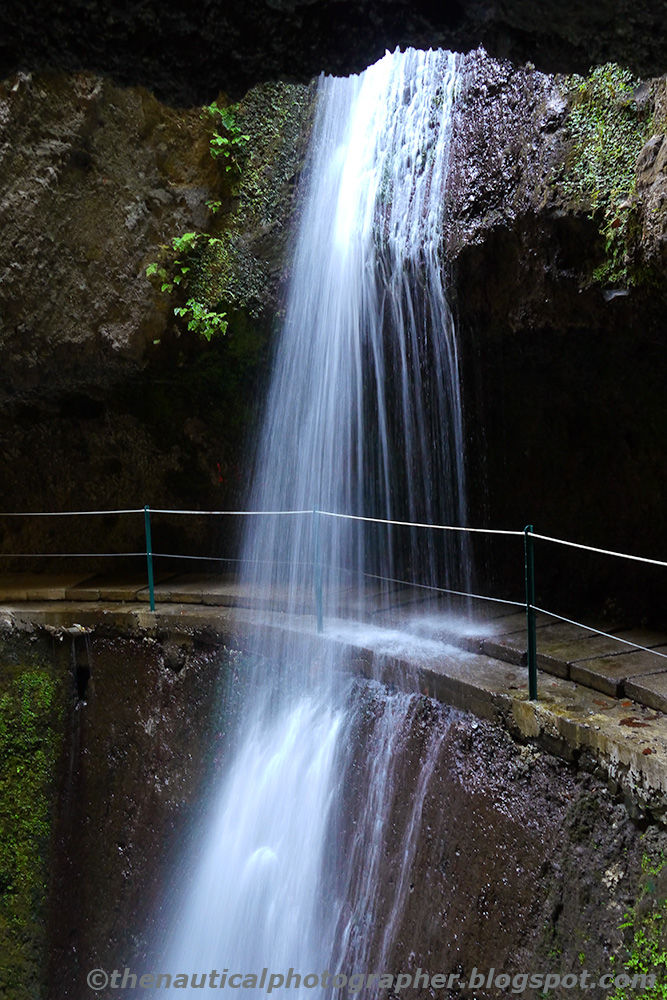
After a one hundred and fifty meter tunnel we reach the most lovely spot of the hike. A deep canyon...
... and the usual waterfall.

The way back, along the Levada do Moinho, is punctuated by wild fruits of all kinds. So, if you happen to forget your daily snacks at home... no worries. We've seen figs, prunes, apples and the ever present and delicious blackberries (pictured) along the way. At least during Summer time, our food problems are solved.

Thus ends the Levada do Moinho, close to the Lombada da Ponta do Sol church. With a small and luxurious garden watered by an aqueduct.
Pictures taken with Panasonic Lumix DMC-GH2 and Panasonic Lumix 14-42mm kit lens.
Post-processing in Adobe Photoshop Lightroom and Adobe Photoshop CS3.

07 July 2012

On the Levada do Rei to Ribeiro Bonito

Levada do Rei is, probably, one of the most luxourious hikes that I had the pleasure to do in the mountains of Madeira. Since its beginning, near the water treatment plant of Quebradas, in S. Jorge, up to the end, in Ribeiro Bonito river bed, we walk along a misty primeval forest, deep in the heart of Laurissilva. It's a ten kilometres round tour along the typical Madeira enchanted forest. Or about three and a half hours in walking pace.
My hiking companion was talking about "Avatar", from James Cameron, and how much the ecological message within that movie was a strange paradox with the natural painting we were part of. According to her its message was quite simple: if we humans keep on despising the natural laws in a natural world in which bosom we also belong, the future will be our unquestionable extinction.
I really don't know why we started to talk about the film. Maybe the deep green forest we were in reminded her of the visually stunning natural scenarios of that multi-million dollar production. However that free association stops right there.
In a world where the word "sustainable" is breaking daily records on the written press, most of the times in a cry of despair, the "levadas" show to us all that is possible to disturb the natural equilibrium without destroying it.
And when we finally arrived to the starting point, about three hours later, we left behind a world of trees, flowers, birds and bugs. And a peaceful water channel running though it. A secular human work-of-art that confounds itself with the surrounding nature. And a creator of life.
Could this be the definitive sustainable human intervention?
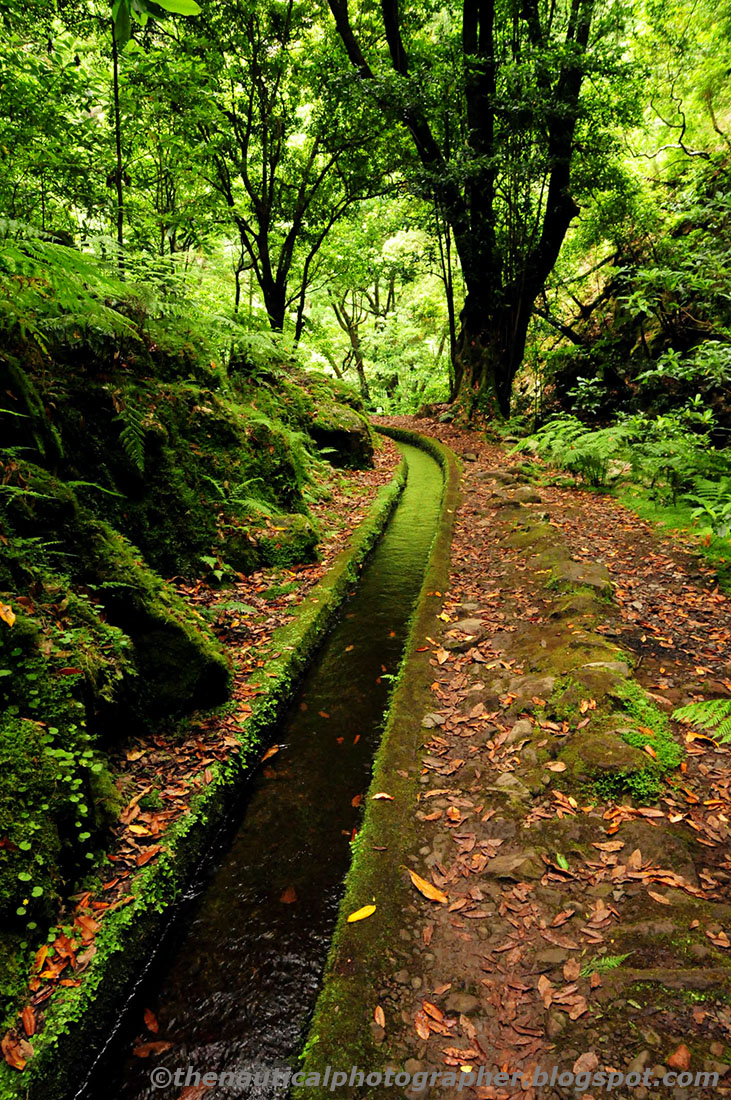
Hundreds of years after their construction, the "levadas" are becoming a part of the natural ecosystem.
Picture taken with Nikon D300 and Sigma DC 18-50mm 1:2.8 EX Macro HSM Lens.
Post-processing in Adobe Photoshop CS3.
A major engineering achievement, the Madeira's secular irrigation system is a work-of-art. A testimony to human ingenuity and sustainable intervention in nature.
Picture taken with Nikon D300 and Sigma DC 18-50mm 1:2.8 EX Macro HSM Lens.
Post-processing in Adobe Photoshop CS3.
The "madre" (meaning "the spring") that feeds the Levada do Rei is located in the Ribeiro Bonito stream bed. Our hike ended here. Where the levada begins.
Picture taken with Nikon D300 and Sigma DC 18-50mm 1:2.8 EX Macro HSM Lens.
Post-processing in Adobe Photoshop CS3.
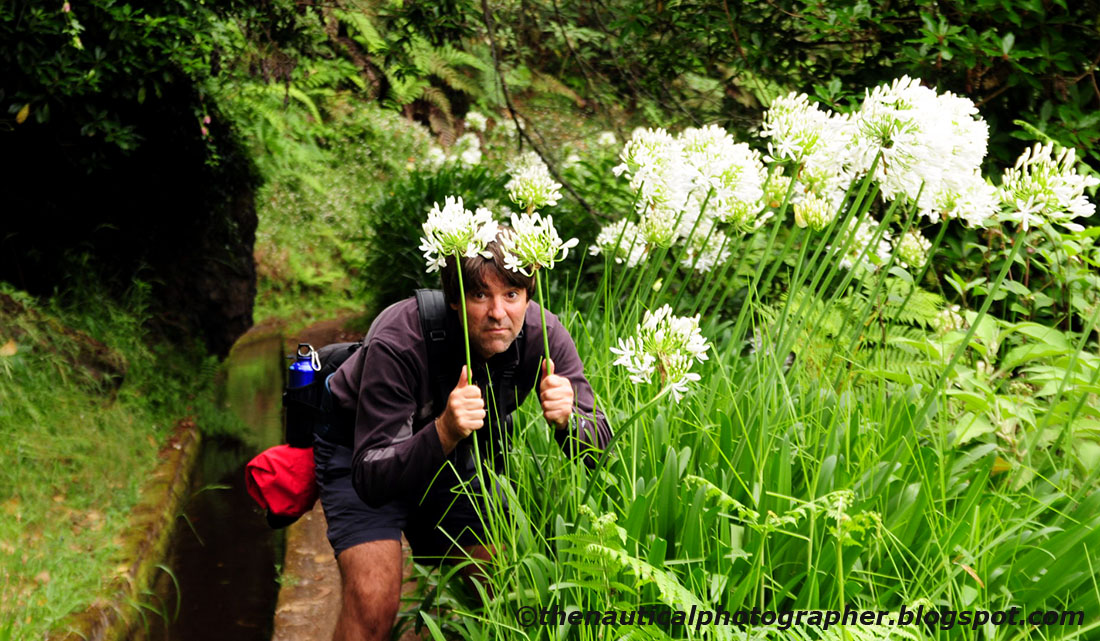
The author advancing through a serious thick jungle of Coroas-de-Henrique (Agapanthus praecox ssp. orientalis) during the first expedition to Ribeiro Bonito. We could hardly see an inch in front of our eyes :-)
Picture taken with Nikon D300 and Sigma DC 18-50mm 1:2.8 EX Macro HSM Lens.
Post-processing in Adobe Photoshop CS3.