Showing posts with label Laurissilva. Show all posts

03 March 2024

Atlantis


An ancient legend, of a lost kingdom and a beautiful princess suffering for an impossible love, gives us a mystical explanation, lost in time, to the formation of one of the most beautiful places in our planet.

Walking along the margins of the Lagoon of the Seven Cities, deep inside the crater with the same name, surrounded by an enchanted and luxurious sub-tropical forest, it's so easy to let our minds drift far away from the mundane scientific geological theories accepted universally for the formation of the world and, instead, dream awake with kings and queens, lonesome princesses and magical powers.

Could this be the lost Kingdom of Atlantis, right under our feet?

Picture taken with Nikon D610 and Nikkor 200mm f4 AI-s lens. Manfrotto tripod and ballhead.


27 March 2020

Fanal - The pristine nature

Some years ago, motivated by a off-duty morning that was promising to be another waiste of precious and useful time if I stayed at home, I drove to the high plateau of Paúl da Serra, with the Fanal Laurissilva rain forest as the final destination.
Approaching this pristine parcel of nature for the first time was indeed a surprise, especially driving along the recently-built ER 209 (Regional Road 209). This strip of tarmac snaking along the primitive forest, particularly the length between Paúl da Serra and Ribeira da Janela, is also a delight to ride if you are a biker:


Nearby, and in a mostly paralell track alongside the ER 209, the PR 13 hiking route is a charming and easy-going trail, suitable for all of those who want to have an  all-around introduction to the Madeira pedestrian nature tourism with the least phisical effort. Just make sure, in advance, that the weather is clear. Most of the times it isn't. Fanal is well known for its foggy weather:


Albeit being a well preserved natural landscape, the Fanal forest also has its share of human presence. Althought not as intensive as decades ago, the pecuary activity still survives in this corner of the Madeiran territory. Shepherd's shelters are common as is livestock alongside the road. All this adds to the enchantment of the place. Just drive safely and slowly, avoiding stressing the animals:


Pictures taken with Nikon Coolpix P7100. Post-processing in Adobe Photoshop Lightroom and Adobe Photoshop.

12 August 2015

Luxuriant

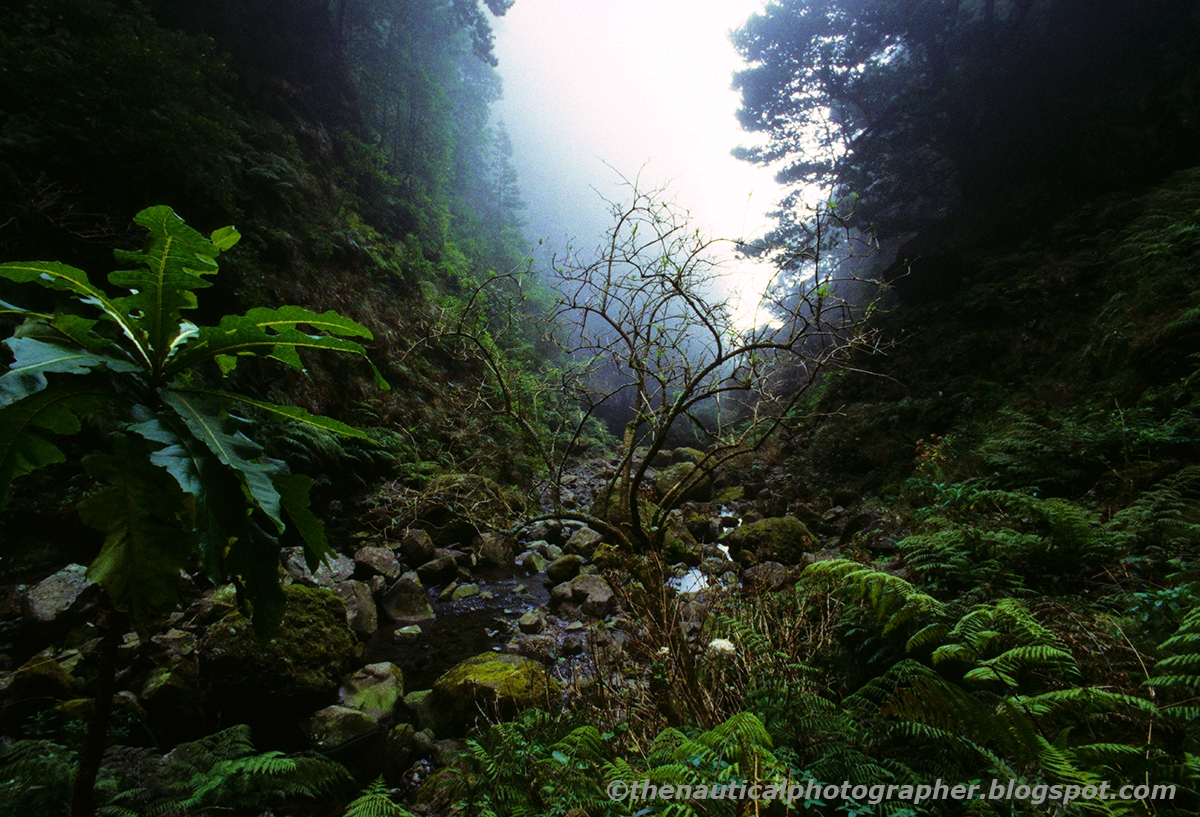
The dense and luxuriant Laurissilva forest in Pico das Pedras, on the North coast of Madeira.
Picture taken with Nikon D300 and Tamron SP AF 90mm f/2.8 Macro lens. Manfrotto tripod and Junior geared head. Post-processing in Adobe Photoshop Lightroom.

13 September 2014

Levada dos Cedros - P.R. 14

The Levada dos Cedros has one of the most handsome sources in all the Madeira's levadas. However, as strange as it may seem, this path is not as visited as its nearest neighbours, in Rabaçal valley. Hidden deep in Fanal, this hike is, nevertheless, a pleasurable one, taking you deep into the Laurissilva forest.
The departure point to Levada dos Cedros source, nearby the ER 209 (Regional Road).
 
Description:
Departure position:
Lat:   32º49'33"N
Long: 017º09'29"W
Altitude: 870 mts
Source (arrival) position:
Lat:    32º47'57"N
Long: 017º08?39"W
Altitude: 910 mts
 
Distance: 5.4 kms
Time:       aprox. 1h30m
The round hike (from departure to departure) will take you about three hours on the trail and nearly eleven kilometres of walking.
 
Wooden bridge in Levada dos Cedros...
The always luxurious vegetation is a constant presence, as we proceed deeper into the Laurissilva, heading to the source of the levada.
The remote and luxuriant source of Levada dos Cedros, deep inside the primeval forest of Fanal. A well-kept Garden of Eden, rightfully deserving a visit and the 5.5 kms long approach march.
Pictures made with Nikon D40X with Nikkor 18-55mm kit lens and Nikon Coolpix P7100. Tripod Sirui T005 for the last picture.
Post-processing of the converted Nikon NEF Raw to TIFF files in Adobe Photoshop Lightroom, ver. 4.1.

06 December 2013

Rural tourism

As the 35th most visited country in the world in 2012 (numbers from the UNWTO), Portugal has, since several decades ago, a mature tourism sector.
The Portuguese hospitality is legendary, and it's rare to find a foreign citizen issuing negative comments on account of a bad touristic experience in our country.
The reasons for this are quite simple: we are a small country and thus (at least for now) quite safe. There are no internal fractures that threatens the nation's social stability, since we, besides being a state, are also a nation (the oldest nation state in Europe, in fact; independent since 1139 and with its sovereignty recognized by the Pope Alexander III, on the year 1179).
On the other hand, we are naturally curious for other cultures. Contrary to the present general philosophy of the so-called (wanna-be)hegemonic states worldwide, we do enjoy to learn. And what a better way to do that than talking to a foreigner. Learning is what we've been doing since the Discoveries.
You don't believe it? Check our globally respected cuisine and you'll know what I mean: you'll find pieces of Africa, the Americas and Asia on it.
So, it's no surprise that, with this modest, interested, down-to-earth and cosmopolitan way of living, our country became a destination for more than 13 million tourists on the past year. You have to recognize that, in a nation of nearly ten million, these are not bad numbers.
Such a strong worldwide demand for Portugal is answered by the country's hospitality industry, which is increasingly complex, year after year.
Nearly forty years ago, after the Carnation Revolution, the country was poor and tourism accommodations were restricted to hotels in the main cities and pensions and hostels in the smaller towns.
Well, a lot has changed since then. Like everywhere in the world, we now have resorts, lodges, motels, you name it.
Increasing in popularity (taking, for that, advantage of the perfect conditions offered by the country for nature tourism) is the rural tourism.
It uses the concept of "casas de campo" (country houses) as accommodation units and it aims at a growing niche in the market: that one of people tired of city noise, pollution and confusion and looking for a more relaxed vacation experience, preferably amidst nature or inserted in a true-to-values community lifestyle.
Portugal has now thousands of these places, many recovered from ancient secular constructions and given a new life from new owners. The autonomous regions of Madeira and Açores are no exception to the national whole.
A couple of days ago, interested in the concept, I accepted a kind invitation from a friend and headed to the North of the island to enjoy a relaxed day, away from the South coast more frivolous existence. The chosen place was the "Moinho do Comandante", or Captain's Mill. Located in the small place of Fajã do Cedro Gordo (São Roque do Faial), this was, previously, an old water mill, used for flour production.
An old building (dated from 1829), the water mill constructed near the Ribeira da Ametade stream changed hands several times in its life until being bought (already in ruins) by the former TAP airline Captain Carlos Melo Vidal in more recent years.
From that time on, an intense reconstruction and expansion work took place, leading to the inauguration, in 1999.
Nowadays, the "Moinho do Comandante", fully integrated in the surrounding landscape, is a fine example of what the "sustainable development" concept means, when particularly related to the tourism industry.
I'm glad to live in a country were thousands of these small good examples keep flourishing.
The "Moinho do Comandante" as seen from the bridge over the Ribeira da Ametade stream...
...and picturing the high peaks above Fajã da Nogueira valley, in the distant horizon.
Covered in green leafs during Spring time, the mill walls exhibit now a more bucolic, autumnal and naked look, nevertheless equally interesting.
The gate bell.
All pictures taken with Nikon D300 and Sigma 70-200mm 1:2.8D APO EX HSM, 18-50mm 1:2.8 EX Macro HSM DC and 10-20mm 1:4-5.6 EX DC HSM lenses. 77mm Hoya HMC Super circular polarizer and Cokin graduated neutral density filters.
Manfrotto 055 NAT3 tripod and 410 Junior Geared Head.
Post-processing of all images in Nikon View NX2 and Adobe Photoshop Lightroom, ver. 4.1

30 September 2012

Chão da Ribeira

Chão da Ribeira is, probably, the loveliest valley in Madeira. Located in the NW coast, close to Seixal, it's basically a suspended valley, about three kilometres long, and cut in the rock by the erosion forces of the Ribeira (stream) do Seixal. Contrary to most mountain valleys in Madeira (which are narrow and deep), its floor (about one kilometre wide) is flat and with good land for agriculture. Therefore, although the valley has no permanent human residents, the lands are well kept and a permanent source of potatoes and other vegetables for their owners.
Due to its altitude above sea level (about 300 meters) and because its opening to NNE, the valley has a moisty climate though all the year. However, the mountain walls around it keep it sheltered from the strong NE winds so typical in Madeira, helping, therefore, the agricultural efforts and making it at the same time one of the best spots in Madeira for a relaxed weekend among nature.
Endemic of Madeira, the Massarocos (Echium Candicans) are one of the symbols of the island and a common presence also in the Chão da Ribeira valley.
Picture taken with Panasonic Lumix DMC-FT3.
Post-processing in Adobe Photoshop CS3.

20 September 2012

Waterfall

Along the forest road connecting the village of Santana to Queimadas (the starting point to one of the most beautiful levadas in Madeira: to Caldeirão Verde) there are a few water streams and waterfalls. This is the land of the green-coloured forests and trouts enjoying their creeks.
And, although the past two years have been quite dry, the Northern forest stills keeps its magic and monochromatic enchantment. Under the green canopy, you'll find people like you passing by, and, just like you, with a strong bond to the natural world. In front of you might lay several miles of a fairytale forest. Made from the same stuff that molds our dreams. And "a river running though it".
Small waterfall in a creek close to Queimadas.
Picture taken with Nikon D300 and Sigma 18-50 f/2.8 EX DC HSM.
Manfrotto tripod and geared head.
Post-processing in Adobe Photoshop CS3.

23 July 2012

The enchanted forest in danger

The climate is changing. There is no more doubt about it. In Madeira, after the dramatic floods of February of 2010, we are now facing two years among the driest in History. We could, eventually, live with that, if it weren't for one additional danger, already taking it's toll: the large scale forest fires.
Until 2010 these were unheard of. However the Summer of that same year changed that, when thousands of acres of mountain vegetation were burn to ashes. From that year on we forgot what Winter time looked like, since the precipitation was scarce.
And now, after a reasonably peaceful year of 2011, we are facing once again the drama of the fires. In just a couple of days vast areas of Ponta do Pargo, Calheta and Santa Cruz were burnt beyond recognition.
Doesn't really matter, presently, to attribute guilt or responsibility for the fires. This should have been a prevention job first. And that failed. Now is a time for reflexion. To prioritize. To understand what went wrong and to correct it for the future. In the end... a political responsibility.
However, one thing is certain: Madeira cannot live without water. And her vegetation cover plays the most important role in producing it. In a time of global warmth, the preservation of our forests is not only a question of aesthetics. It's a matter of survival.
Nearby Madeira, the semi-desertic (although beautiful) island of Porto Santo is a dramatic example of how the lack of water can have a decisive impact on the landscape. And on the human societies living on it. That can be the future of Madeira (and the continental Portugal also) if nothing is done. If no prevention is made. If we keep letting the forests being burn faster than we can protect them.
Portugal, as a whole, depends heavily on tourism to survive. It's one of our biggest sources of income (in Madeira, particularly, it's the biggest). And people visit us because we have a lovely climate, gentle people, rich History and... beautiful nature.
We have to ask ourselves if the only thing, in the future, we have (and want) to offer them is scorched earth.
The pristine Laurissilva forest, near Caldeirão Verde. One of the most visited spots in Madeira, for the nature tourism. This enchanted forest has managed to be kept safe from fires. For how long?
Picture taken with Nikon F100 and Tokina AT-X Pro 17mm f/1:3.5.
Fujichrome Velvia ASA 50 scanned in Nikon Coolscan V ED.
Post-processing in Adobe Photoshop CS3.

20 June 2012

Fanal - In the heart of the Laurissilva forest

I've read somewhere that the early Madeira discoverers found an island covered in a dense, enchanted and pristine subtropical forest. Quite similar to the one existing in the continental Europe, before the last glaciation age, some 20000 years ago, wiped it out of the map. The forest that we, nowadays, know by the name of "Laurissilva". By our present standards, this was, probably, a natural paradise.
But... being us what we are... things wouldn't last too long. As soon as the first settlers arrived on the island they started the deforestation of the South coast with the objective of cleaning the ground for agricultural purposes. However, doing it with saw and axe was to much of a trouble, so they opted instead for the use of matches. And they torched the island.
According to the historians, the fires were so big and vast that several years later the island was still burning and, as a consequence, a large part of her natural heritage was lost forever.
Thankfully, most of that nonsense intervention was made along the South coast, where the climate was gentler and the land was attractive for farming. The vast majority of the North coast, however, with its harsh weather and abrupt orography, was spared from a similar fate.
So, presently, the surviving ancient Laurissilva forest in Madeira occupies an area that goes from Santana to Porto Moniz, passing thru the high peaks of the Central Massif and Paúl da Serra until the large valleys of Ribeira do Seixal and Ribeira da Janela. Amidst these two, hanging at the Northwest edge of the plateau formation called Paúl da Serra, lies the forest park known as "Fanal". My brother's visit to Madeira was the catalyst I needed to explore that remote corner of the island. Suspended between land and sea and between past and present, the Fanal is a time travel within your spirit and in your senses. And surprised both of us.
It truly is the heart of the Laurissilva forest.
The entrance to the Fanal park, as seen from the wooden stairway leading to the forest house.
Picture made with Panasonic Lumix DMC-GH2 and Panasonic Lumix G Vario 1:3.5-5.6/14-42mm Asph. lens.
Post-processing in Adobe Photoshop CS3.

Rock formation on the NW part of the park and facing the Ribeira Funda valley.
Picture made with Panasonic Lumix DMC-GH2 and Panasonic Lumix G Vario 1:3.5-5.6/14-42mm Asph. lens.
Post-processing in Adobe Photoshop CS3.
Under the canopy of an ancient tree, aiming the lens to the distant horizon.
Picture made with Panasonic Lumix DMC-GH2 and Panasonic Lumix G Vario 1:3.5-5.6/14-42mm Asph. lens.
Post-processing in Adobe Photoshop CS3.
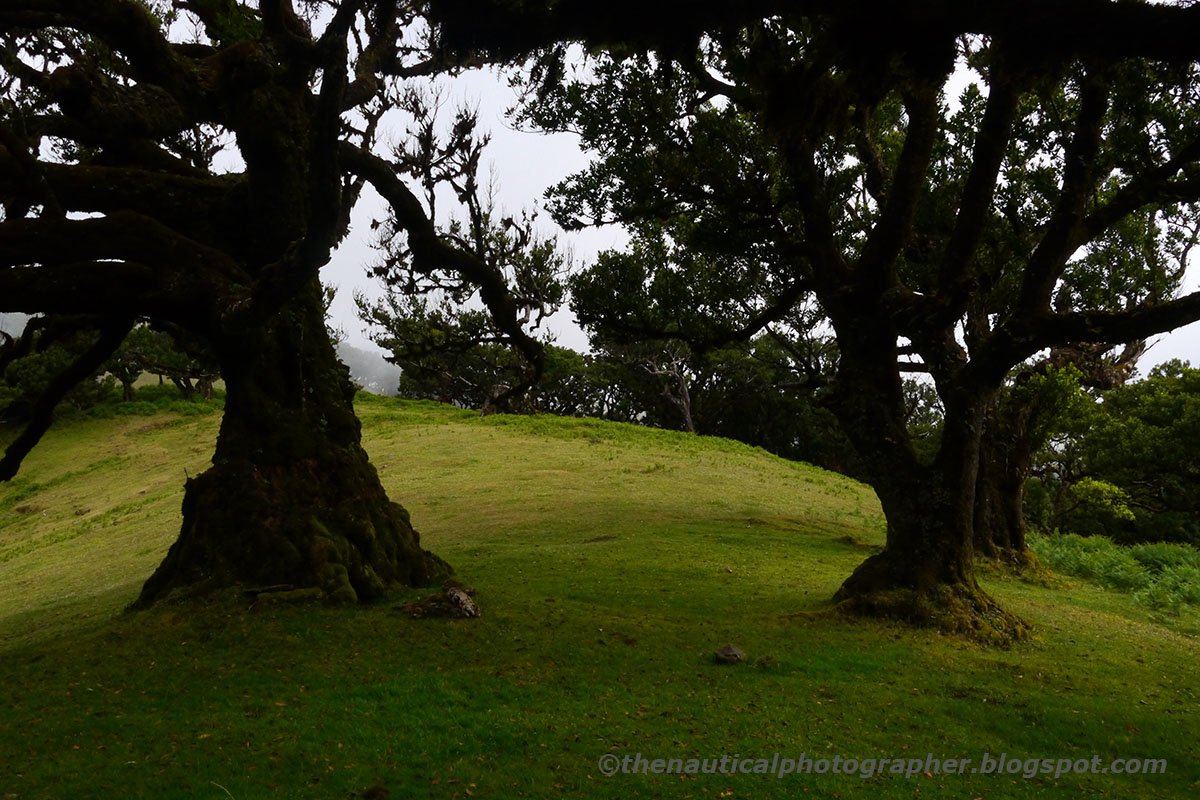
The secular and primeval vegetation of Fanal gives the park a otherworldly atmosphere.
Picture made with Panasonic Lumix DMC-GH2 and Panasonic Lumix G Vario 1:3.5-5.6/14-42mm Asph. lens.
Post-processing in Adobe Photoshop CS3.
Besides birds and bugs, the sole permanent occupants of the place are cool cows.
Picture made with Panasonic Lumix DMC-GH2 and Panasonic Lumix G Vario 1:3.5-5.6/14-42mm Asph. lens.
Post-processing in Adobe Photoshop CS3.
My brother Rui approaching a vertiginous cliff, from where we had a magnificent vista over the Ribeira Funda valley.
Picture made with Panasonic Lumix DMC-GH2 and Panasonic Lumix G Vario 1:3.5-5.6/14-42mm Asph. lens.
Post-processing in Adobe Photoshop CS3.
The grassy Fanal plateau, from a nearby hill. On the top of the picture you can see a artificial pond, used for livestock watering.
Picture made with Panasonic Lumix DMC-GH2 and Panasonic Lumix G Vario 1:3.5-5.6/14-42mm Asph. lens.
Post-processing in Adobe Photoshop CS3.